In contemporary societies, emergency is no longer an exception: it has become a permanent condition. Moreover, it is not a single emergency but a set of interconnected crises – biodiversity loss, climate change, migration, pandemics, wars, and poverty – that interact through cascading effects and increasingly take on a chronic character, producing what can be described as a condition of polycrisis.
The climate crisis, in particular, has a profound impact on cities. It manifests itself through extreme events such as prolonged heatwaves, intensified by the scarcity and fragmentation of urban green spaces, and intense rainfall, which is intercepted by highly impermeable urban soils. These hazards are compounded by high levels of urban vulnerability, affecting both the physical dimension of spaces, buildings, and infrastructure, and the social dimension, shaped by growing inequalities and widening socio-economic gaps.
“Based on research experiences in Italy and study periods in Sweden and Japan, the first consideration is that when discussing the relationship between the climate crisis and cities, it is necessary to adopt a multi-hazard approach. This perspective does not isolate risk factors but integrates them into a systemic vision that connects Disaster Risk Reduction and Climate Change Adaptation. For design disciplines, this means incorporating emergency prevention into planning and design processes at different scales, in order to ensure safety, health, and accessibility in urban spaces,” explains Maria Vittoria Arnetoli, researcher at the University of Florence. She immediately introduces the concept of resilience: “The term resilience is closely linked to the type of system, engineering, ecosystemic, or socio-ecological, that is affected by disturbance and to the intention of restoring a previous state of equilibrium. Cities, however, understood as complex socio-ecological systems, are rarely in equilibrium and almost never reach an ideal or perfect configuration.” For this reason, in urban contexts the principle of bounce forward is preferred over bounce back. “Restoring the pre-event condition is neither possible nor desirable. A resilient city is one that can seize the window of opportunity that opens after an emergency and organize the post-event phase with the goal of improving pre-disaster conditions.” Orienting urban regeneration toward the development of transformative, adaptive, and responsive capacities requires a profound paradigm shift. To be implemented, this shift demands new decision-making and planning models, operational tools, and evaluation indicators grounded in scientific data.
Guiding us through this dimension is Giulia Guerri, researcher at the Institute of Bioeconomy of the National Research Council (CNR-IBE). “Our contribution to these reflections is as concrete as possible and grounded in real-world data. We analyze satellite data integrated with other climatic, environmental, and land-cover information. On this basis, we develop predictive microclimatic models and design scenarios aimed at mitigating the urban heat island phenomenon. We study variables such as air and surface temperature, together with specific outdoor thermal stress indicators. Our goal is to anticipate the effects and impacts that can influence the liveability of urban spaces.” This approach makes visible what often remains implicit: the city is not a uniform body but rather a mosaic of different microclimates.
“And this is also part of the researcher’s challenge,” Guerri continues. “We do not simply produce scientific data; we also work to understand how this data can translate into concrete actions and operational tools at the territorial level, integrating them into models capable of improving quality of life in urban contexts.” A clear example is the MIRIFICUS project, funded by the Italian Space Agency and coordinated by CNR-IBE in collaboration with ISPRA and other institutional partners. The project uses high-resolution satellite data from multiple missions – including Copernicus, Landsat, PRISMA, and COSMO-SkyMed – to analyze the urban heat island phenomenon and monitor over time the effects of urban reforestation interventions.
“We map the areas that are most critical from a thermal perspective, identifying where urban overheating is most intense,” explains Guerri. “This information is then integrated into an interactive cartographic platform, a WebGIS, which allows public administrations to consult environmental indicators, maps, and data useful for planning targeted interventions.” These analyses combine surface temperature, land cover, vegetation indices, and other microclimatic indicators and are conducted at multiple scales: nationally across regional capitals and, in greater detail, in specific urban areas such as Rome and Florence, where the project evaluates the effectiveness of urban reforestation before and after implementation.
“The objective is to provide concrete tools for those responsible for territorial decision-making,” Guerri adds. “Knowing where to intervene is the first step, but it is not enough.”
This is where research enters a more delicate phase. When moving from diagnosis to intervention, the question is not only where to act but also how to do so. Not all solutions are equivalent, and poorly designed choices can generate unintended effects on the urban microclimate and on the overall liveability of cities.
Here Arnetoli highlights a fundamental distinction between hard solutions, which require significant investment and tend to be rigid, highly sophisticated, and technically complex, and soft solutions, which prioritize natural capital and adopt a low-tech, community-based approach. “Hard solutions, typically derived from specialized approaches and top-down decision-making models, respond to the problem with large-scale infrastructural interventions. For example, in water management during intense rainfall, large containment infrastructures can effectively handle peak flows, but they are often rigid and separated from the city, providing little benefit to local communities in terms of urban space quality and liveability.”
By contrast, she continues, “a soft approach, although designed to manage smaller volumes, works to retain and manage water as locally as possible: through depaving, permeabilization, the introduction of wetlands, rain gardens, or systems for collecting, storing, and reusing rainwater.” In this case, the goal is not only to contain water but to rethink urban soil, the skin of the city, so that it can absorb, slow down, and reuse rainfall, integrating hydraulic performance, environmental quality, and well-being in public space. Public engagement also plays a crucial role, as demonstrated by the Code4Risk project, which promotes co-creation processes aimed at strengthening awareness of risk, emergencies, and resilience, and thus fostering a broader culture of risk.
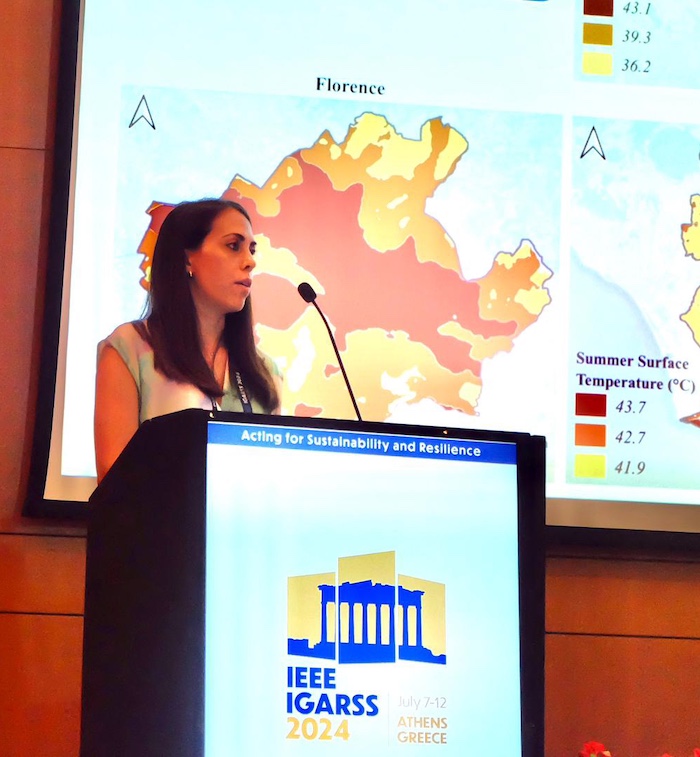
Giulia Guerri provides a very concrete example linked to ongoing fieldwork. “We are currently running simulations on public spaces in Florence, in collaboration with the Fondazione Capellino and the Municipality, to evaluate the effectiveness of different design solutions for squares, streets, and other urban areas. The idea is to compare scenarios and understand, both ex ante and ex post, what truly works from a microclimatic perspective.” This work is part of the Firenze Climate Change project, an experimental initiative launched in 2023 to design, implement, and monitor nature-based solutions capable of mitigating the effects of climate change in cities while improving biodiversity and citizens’ quality of life. Several pilot areas have been identified across Florence, functioning as a real open-air urban laboratory where design solutions are tested and their effects on variables such as temperature, air quality, and biodiversity are monitored over time through systematic measurements conducted before and after interventions.
“It is not simply about planting trees or adding urban greenery,” Guerri emphasizes. “The key point is to measure the real impact of different solutions in order to understand which ones work best in different urban contexts.”
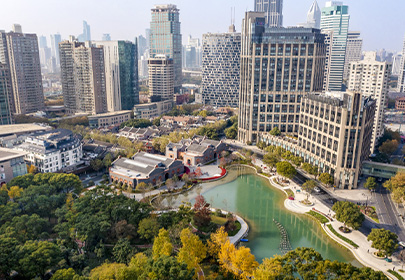
This approach is already well established in case studies outside Italy. “Cities such as Copenhagen, with the Saint Kjeld district, as well as adaptive regeneration strategies in Rotterdam, Barcelona, and Paris,” Arnetoli notes, “are excellent examples of contexts where climate adaptation has become a structural component of urban policy rather than an episodic intervention.”
Looking at everyday life in these spaces highlights another dimension: a resilient city must also ensure continuity in daily activities, working conditions, and public health, with direct implications for the overall efficiency of urban systems. “These aspects are central to the national Worklimate project, coordinated by CNR-IBE and INAIL, which studies the impact of extreme temperatures on health, safety, and productivity in working environments,” explains Guerri. “The project integrates climatic, epidemiological, and occupational injury data to develop operational tools and warning systems that companies can use to adapt work schedules, plan breaks, and adopt preventive measures, also through specific risk maps.”
Today it is no longer possible to speak of the “climate emergency” as a temporary or exceptional event. The change has a chronic character, and cities must learn to live with new baseline conditions in a long-term perspective. “A torrential rainfall is a shock. A heatwave is a stress that can last for days or even weeks. But if the context changes permanently, then operational tools and governance models must evolve as well. In this cultural transition, universities have a major responsibility to make knowledge open, shared, accessible, and actionable,” emphasizes Maria Vittoria Arnetoli.
“Developing and making operational tools available is essential,” echoes Giulia Guerri. “This is why we provide open-source platforms that administrations, architects, and companies can consult and navigate in order to interrogate data and identify the most critical areas — for example in terms of temperature.”
Guerri and Arnetoli point in the same direction: transforming resilience from a buzzword into a concrete practice. It is in this shift, from reaction to anticipation, from event to scenario, from isolated interventions to integrated strategies, that urban fragility ceases to be only a limitation and becomes a lever for redesigning and regenerating cities, making them better equipped to face the unpredictable.
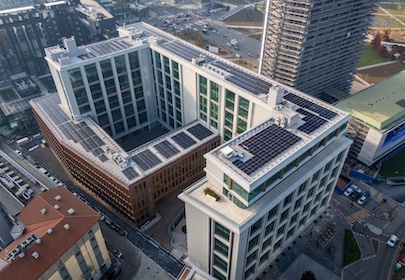
This same perspective underpins the whitebook Building Resilient Cities developed by COIMA and the IUAV University of Venice, which translates these reflections into operational tools at both urban and real estate scales. Through morpho-climatic mapping, Climate Risk and Vulnerability Assessments (CRVA), and the integrated use of satellite data, microclimatic indicators, and socio-economic information, the report demonstrates how urban climate knowledge can inform very concrete choices: from selecting sites less exposed to extreme heat and flooding to designing neighborhoods that combine nature-based solutions with “hard” infrastructure, and managing urban assets dynamically over time. In other words, the platforms and models described by Guerri and Arnetoli find a real-world testing ground in Milan – particularly in case studies such as the Porta Nuova district and the Pirelli 35 mixed-use office and retail complex – where resilience moves beyond an abstract concept and becomes a criterion for design, investment, and urban governance. It is precisely in this transition, from risk measurement to its structural integration into development decisions, that the fragility of contemporary cities becomes an opportunity to rethink their form, functions, and relationships with those who inhabit them.