- The Steering Committee of the Impact Fund promotes the first impact report of a national real economy fund and a public event to engage all stakeholders, contributing to the country’s industrial transition
- Over five years, more than €5 billion in domestic and international capital has been mobilized for urban regeneration and building reuse projects in Milan and Rome, with a projected total exceeding €10 billion over the life of the fund
- Operational collaborations have been established through both public-private partnerships and partnerships with national and international operators
- The Impact Fund has been recognized by GRESB among the top 40 global funds as a Global Sector Leader out of more than 2,000 candidates
- The experience gained from ongoing investments has contributed to the development of a priority agenda by the Steering Committee
Rome, March 25, 2025 – The COIMA ESG City Impact Fund (“Impact Fund”) includes leading Italian institutional investors, such as Cassa Forense, ENPAM, Inarcassa, Cassa dei Dottori Commercialisti, Intesa Sanpaolo Group, Compagnia di San Paolo, Fondazione Padova e Rovigo, Monte dei Paschi di Siena Pension Fund, ENPACL, and the National BCC-CRA Pension Fund. The fund represents one of the first examples in Italy of a real estate fund structured according to impact investing principles, aiming to simultaneously generate financial, environmental, and social returns, with quantitative targets defined ex ante.
To date, the fund has mobilized a total of €5 billion through strategic partnerships and co-investments involving leading national and international institutions, including three sovereign wealth funds and major global pension funds.
The Impact Fund Steering Committee – promoted and managed by COIMA – is composed of: Nunzio Luciano (Chairman), Alberto Oliveti (ENPAM), Maria Annunziata (Cassa Forense), Ferdinando Boccia (CNPADC), Michele Dapri (Intesa Sanpaolo), and independent members Ersilia Vaudo Scarpetta, Meka Brunel, and Giovanna Melandri.
The Committee has promoted the development of the first impact report for a national real economy investment fund, along with a public forum for discussion and engagement with key stakeholders. The objective is to foster knowledge exchange and expand the collaborative model adopted, accelerating and amplifying Italy’s industrial transition as a driver of economic, social, and environmental development.
The Fund – internationally recognized as a leader in ESG performance in the real estate sector (Global Sector Leader in the GRESB benchmark, with a score of 99/100 and a 5-star rating) – represents a tangible example of COIMA’s and its investors’ commitment to developing more sustainable, inclusive, and resilient cities, demonstrating how urban regeneration can become a driver of economic growth and long-term value creation for the country.
The event
The Steering Committee of the Impact Fund promoted an open discussion with public and private stakeholders on key priorities for territorial transition, supporting the country’s economic, environmental, and social development.
The results of the fund’s first Impact Report, prepared by COIMA with scientific contributions from The European House – Ambrosetti (TEHA) and Human Foundation, were presented in Rome at the MAXXI Auditorium during the event titled: “Italy, Real Investments: Urban Development, Social Cohesion, and Economic Growth.”
Following a welcome address by Emanuela Bruni (President of MAXXI) and institutional greetings from Antonella Polimeni (Rector, Sapienza University of Rome) and Davide Albertini Petroni (President, Assoimmobiliare), proceedings opened with remarks by Cardinal Matteo Maria Zuppi (President of CEI). This was followed by sessions on “Structural Conditions for Creating Impact in the Italian Economy” by Antonino Turicchi (CEO, CDP Real Asset SGR), “Creating Impact Through Investments in the Real Economy” by Manfredi Catella (Founder and CEO, COIMA), “The Impact of the COIMA ESG City Impact Fund” by Gabriele Bonfiglioli (Chief Investment Officer, COIMA), Kelly Russell Catella (Head of Sustainability and Communication, COIMA) and Stefano Corbella (Sustainability Officer, COIMA).
The discussion started from the concrete experiences of the Impact Fund, represented in an objective and measured way in the impact report prepared on the initiative of the Steering Committee, and was structured around two roundtables: the first on “Impact Investments” with Valerio De Molli (Managing Partner and Chief Executive Officer, The European House – Ambrosetti), Giovanna Melandri (Chair, Human Foundation), Ersilia Vaudo Scarpetta (Special Advisor for Future Talents, European Space Agency) and Andrea Tobia Zevi (Councillor for Assets and Housing Policies, Municipality of Rome); the second on the topic “Investing in the Real Economy” with Nunzio Luciano (Chair of EMAPI and Chair of the Steering Committee of the Impact Fund), Maria Annunziata (Chair of the National Fund for Welfare and Assistance of Lawyers), Ferdinando Boccia (Chair of CDC and of the Advisory Committee of the Impact Fund), Alberto Oliveti (Chair of ENPAM), followed by concluding remarks by Gregorio De Felice (Chief Economist and Head of Research at Intesa Sanpaolo).
Since 2020, the Impact Fund has mobilized resources, expertise and vision to help address structural challenges facing the country: the environmental transition, the housing emergency, technological integration and the need for resilient infrastructure.
The methodology adopted for the Impact Fund is structured around three pillars:
- industrial: through transformation initiatives and the physical development of infrastructure;
- scientific: KPIs and quantitative targets are defined ex ante and regularly monitored in their evolution, particularly with regard to positive or negative deviations, establishing management actions or adjustments to objectives and implementation for other investments and projects;
- experimental: necessarily based on an iterative process with progressive adjustments grounded in deviations from a scientific approach.
A further distinctive element of the Fund is its ability to scale capital and impact through an open architecture enabled by strategic partnerships and financing. Against approximately €1 billion of its own capital, the Fund has activated a financial multiplier of 5.1x, with the potential for total investments of up to €5 billion, thanks to co-investments, public-private partnerships and financial leverage, and also sets a target, considering the full potential of projects already acquired, of over €12 billion, with a financial multiplier of 12x. A model that demonstrates how institutional capital can act as a systemic catalyst, transforming every euro invested into a driver of territorial development.
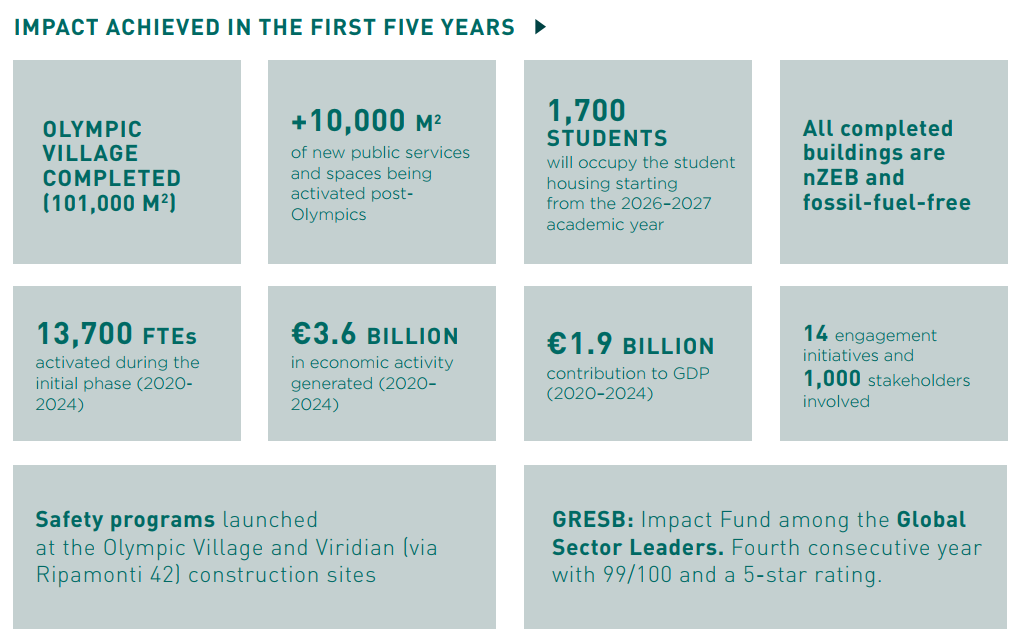
In its first five years, the Fund has launched initiatives of high symbolic value, such as the construction of the Olympic Village, which will become, for the 2026/2027 academic year, the largest affiliated student residence in Italy with 1,700 beds, the regeneration of Scalo di Porta Romana and MilanoSesto in Milan, and of the former Guido Reni barracks in Rome. From an environmental standpoint, all completed buildings are fossil fuel free, nZEB and in Energy Class A, with over 1.4 MW of installed photovoltaic capacity planned.
Impact investing represents an evolution of the fiduciary responsibility of institutional investors, who are called upon to preserve capital and achieve returns consistent with their risk profile. In the case of the Impact Fund, the target return (a net portfolio IRR of approximately 10%) envisages the full integration of economic return with environmental and social impact, in order to strengthen performance synergistically.
The projects promoted by the Fund focus on large-scale urban regeneration programs, with an approach that prioritizes the redevelopment of already urbanized areas and the creation of new sustainable and inclusive neighborhoods.
Among the main initiatives launched are:
- the regeneration of the former Scalo di Porta Romana in Milan, which includes the Olympic Village for the Milan Cortina 2026 Games, designed to become the largest affiliated student residence in Italy with 1,700 beds;
- the MilanoSesto project, the largest urban regeneration program in Italy and one of the largest in Europe;
- the redevelopment of the historic former Guido Reni barracks in Rome, contributing to the regeneration of the Flaminio district.
Overall, in its first years of activity, the Fund’s investments have generated significant results for the real economy:
- 13,700 jobs activated across the economic value chain
- €3.6 billion in economic activity generated
- €1.9 billion contribution to national GDP
From a social and urban perspective, the projects also envisage the development of over 13,300 new housing units, including approximately 2,400 at controlled prices, and 1,700 student beds.
The agenda for urban regeneration
During the event, a shared reflection emerged among investors, institutions and industry operators on the strategic role of urban regeneration for the country’s development.
Participants highlighted how urban regeneration can act as an economic accelerator of the energy transition and social cohesion, provided that certain enabling conditions are created
Among the main priorities identified:
- define a national strategy for urban regeneration, including mapping of priority areas and measurable targets
- introduce faster and more predictable authorization procedures for urban transformation projects
- enhance unused public real estate assets through public-private partnerships
- mobilize private capital through dedicated financial instruments and public de-risking mechanisms
- strengthen stable governance among Government, Public Administration and investors to monitor progress on urban transition objectives.
These considerations highlight how urban regeneration can become one of the main investment platforms for the Italian real economy in the coming years.
Manfredi Catella, CEO and Founder, COIMA SGR: “The industrial transition of the Italian territory represents one of the drivers of economic, environmental and social development for the country’s future. The relatively early stage of the urban regeneration cycle in our cities allows us to equip ourselves with an updated agenda compared to other countries at a more advanced stage. The ability to innovate and to implement by combining skills, knowledge and capital is the extraordinary opportunity we have, and this is the purpose of this day of discussion promoted by the Steering Committee of the Impact Fund.”
Davide Albertini Petroni, President of Confindustria Assoimmobiliare: “The real estate sector is undergoing a paradigm shift: the transition from a sector focused on the value of the building as a financial asset to one based on the value generated by the building within the territorial context in which it is located.
In this perspective, the property becomes part of a territorial ecosystem: it generates value not only for its intrinsic characteristics but because it enables economic activities, attracts companies and talent, promotes innovation, and improves the quality of urban life.
For this to happen, we must strengthen integrated planning between the public and private sectors, in which urban planning objectives, the economic sustainability of real estate investments and the satisfaction of collective interests are coherently aligned; at the same time, the way we measure the value of real estate investments must also evolve: alongside traditional financial indicators, new factors must gain greater relevance, including the economic impact on the territory, the social value generated and the contribution to the energy transition.”
Antonino Turicchi, Chief Executive Officer of CDP Real Asset SGR: “Our objective is to create the conditions to generate impact on the real economy. For over fifteen years, CDP Real Asset has been working to develop a major social housing program, built together with a network of leading institutional investors – banks, insurance companies, pension funds – which at the time chose to support us not only for an investment opportunity, but out of a sense of responsibility towards the country. Together we have introduced and grown social housing in Italy.Today the housing crisis is even more severe. And precisely for this reason, now is the time to renew that commitment. For our part, we continue to invest with determination: we hope that institutional investors who believed in this project will once again invest alongside us.”
Andrea Tobia Zevi, Councillor for Assets and Housing Policies, Municipality of Rome: “Impact investing is now a concrete instrument of urban governance, including for a city like Rome. For us administrators, it means regenerating neighborhoods, reducing inequalities, and creating social as well as economic value. Urban regeneration, from this perspective, ceases to be merely a construction-related operation and becomes an integrated policy: affordable housing, high-quality public spaces, local services, cultural opportunities, but also employment. For this reason, in the projects for the enhancement of Rome’s public assets that we are carrying forward, we seek to maintain a very clear political vision: defining priorities, ensuring transparent rules, and selecting projects capable of generating lasting benefits. It is a change of direction for the public sector, but also for the private sector, which accepts the challenge of investing where it is worthwhile and, above all, where it is needed. What is at stake is not only the transformation of cities, but the very credibility of institutions in guiding more equitable, inclusive and sustainable development. Opportunities like this are essential to align public vision and private resources, identifying pathways consistent with the collective interest.”
Nunzio Luciano, President of EMAPI: “A system-wide initiative promoted by the social security funds of self-employed professionals, which then expands to include the largest Italian bank, pension funds and banking foundations. A pilot example of a unique urban regeneration project aimed at enhancing the economic, social and environmental development of our country.”
Maria Annunziata, President of the National Fund for Welfare and Assistance of Lawyers: “The regeneration of real estate assets is undergoing a paradigm shift: from an ordinary administrative tool to be reshaped into an industrial process of public interest; from simple maintenance to strategic enhancement. Without further innovative legislative measures, integrated with effective and efficient urban planning, energy, infrastructure, social and financial solutions, it is not possible to build credible, sustainable regeneration plans capable of attracting private capital while also ensuring solidity for institutional investors.”
Ferdinando Boccia, President of the Chartered Accountants’ Pension Fund: “It has been a great pleasure for me to take part in this discussion, which places urban regeneration at the center as a lever for the development of the real economy. Supporting it means concretely contributing to the country’s growth, while at the same time strengthening the long-term sustainability of pension systems. As the Chartered Accountants’ Pension Fund, it is important to continue investing in long-term sustainable models, not only from an economic perspective, but also a social one. However, to achieve this, a shared vision among all stakeholders is essential, enabling the facilitation and simplification of investments through stable strategies and consistent fiscal and financial measures.”
Alberto Oliveti, President of ENPAM: “ENPAM’s commitment to investments linked to urban regeneration responds to the need to create a measurable and significant impact on the country system, while at the same time ensuring returns that support the sustainability of the Foundation’s pension system.”