The project continues to progress on schedule, with significant advancements in infrastructure, environmental remediation and enabling works supporting the area’s urban development. These activities are paving the way for the development of the City of Health and Research, the Unione Zero district, and the initial phases of the MilanoSesto masterplan:
Once fully underway, the MilanoSesto project has the potential to help address housing demand across the Milan metropolitan area by delivering more than 10,000 new residential units, in line with national and local housing policy frameworks currently under development, including the Housing Plan.
Sesto San Giovanni, 18 June 2026 – With regard to the planned works across the development area, MilanoSesto SICAF (“MilanoSesto”, the “Company” or the “SICAF”) – jointly owned on a 50:50 basis by COIMA Sesto Fund and Redo Sesto Fund – continues to deliver the planned public infrastructure works in line with the project timetable and confirms that it has updated the programme for the private development works, with the objective of establishing the conditions necessary to deliver an economic, environmental and social development project that responds to the needs of the city and the wider metropolitan area. During the Shareholders’ Meeting, the Company also approved its financial statements for the year ended 31 December 2025.
As the promoter of the urban regeneration project for the former Falck industrial site – the largest such project in Italy and one of the most significant in Europe – MilanoSesto achieved substantial progress during 2025 across the project’s key enabling components, including public infrastructure works, environmental remediation, planning and urban development activities, as well as initiatives aimed at activating and enhancing the area through temporary uses. These achievements demonstrate continued progress in the transformation of the site by delivering the conditions required for the development of the City of Health and Research, the Unione Zero district, and the launch of the initial implementation phases of the broader MilanoSesto masterplan.
2025 marked MilanoSesto’s second full financial year following the change of control completed in November 2023, and its first full year of operations as a SICAF. During the first two years under the current management, priority was given to restoring the Company’s financial position through a comprehensive deleveraging and recapitalisation programme, laying the foundations for the site’s long-term urban development. At the same time, management worked closely with the lending banks to support the evolution of their role from lenders to investors in the project, while also securing additional sources of financing .
The Company’s conversion into an externally managed SICAF has also streamlined its corporate and governance structure, positioning MilanoSesto as a more efficient, flexible and attractive investment platform for institutional capital.
Financial Year 2025
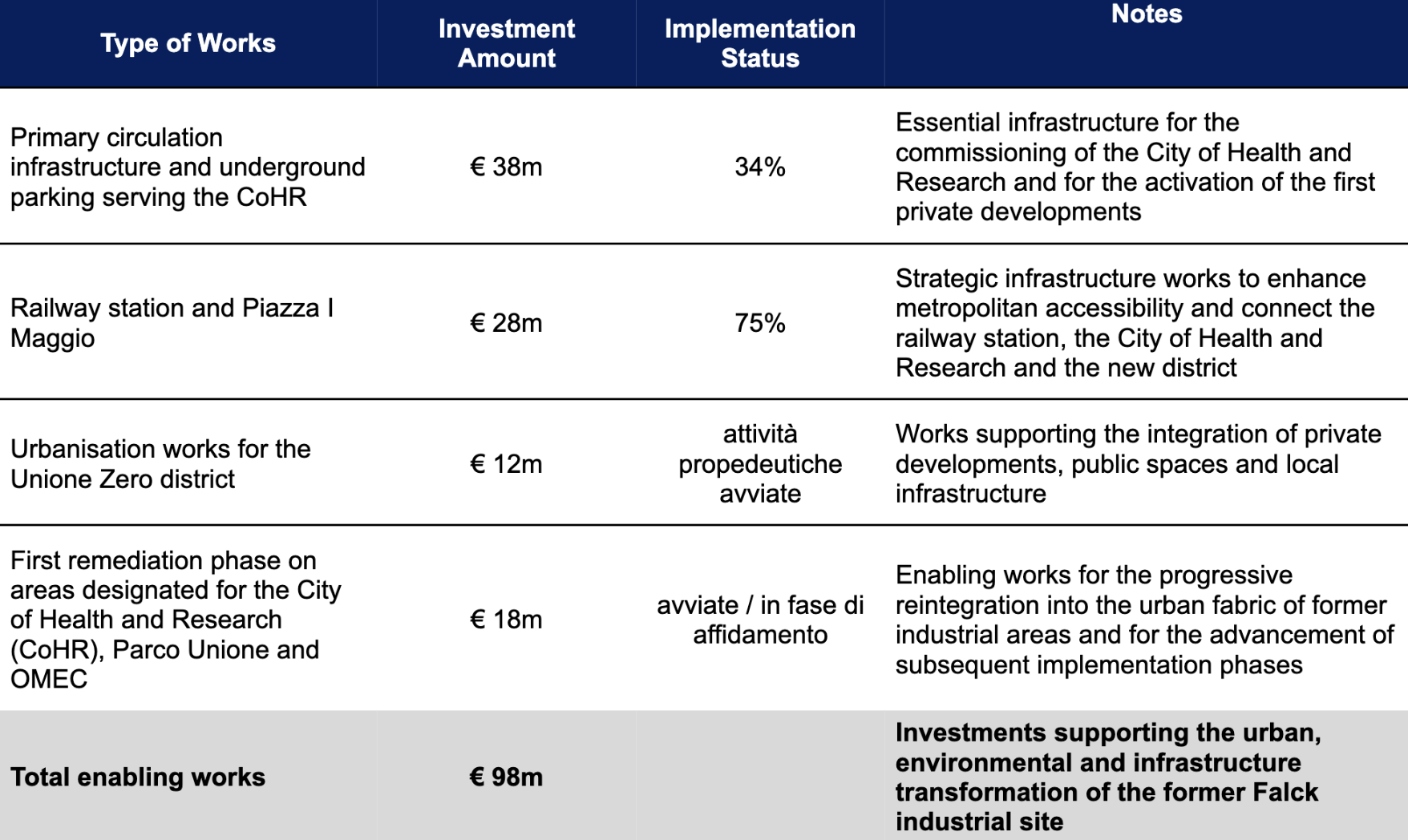
Among the main interventions, the procurement process was completed and, in April 2025, construction works commenced on the primary road infrastructure and underground parking serving the City of Health and Research, representing an investment of approximately €38 million . The works are currently in the execution phase and, as of the first quarter of 2026, have reached approximately 34% completion , in line with the recovery programme submitted by the contractor.
In addition, in coordination with RFI, work has continued on the new Sesto Primo Maggio FS over-station railway facility , representing an investment of approximately €28 million . Construction activities are at an advanced stage, with progress reaching approximately 75% as of March 2026.
At the same time, preparatory activities have been launched for the urbanisation works in the Unione Zero district, with an estimated investment of approximately €12 million , following an integrated operational model alongside private developments, aimed at optimising timelines, construction phases and site coordination.
From a financial and economic perspective, the Company’s result primarily reflects the update of real estate valuations, which incorporate the realignment of the implementation timeline of the Business Plan and the related urban planning and administrative process . These dynamics occur within an early-stage development phase, still characterised by the absence of recurring revenues and the execution of major enabling works. However, such factors do not alter the project’s industrial rationale, which remains focused on the progressive activation of its various urban and functional components.
MilanoSesto has also continued its temporary activation and site enhancement initiatives , aimed at re-establishing the relationship between the former Falck industrial areas and the city through temporary uses of portions of the site, which form an integral part of the municipal territory of Sesto San Giovanni and are not ordinarily accessible to the public. Within this framework, several large-scale public events have been hosted, including Cirque du Soleil and Balloon Museum, with Jurassic World scheduled to open at the end of June 2026. These initiatives are intended to enhance the area’s attractiveness, visibility and presence.
Overall, these actions form part of a broader financial stabilisation path initiated by management in the early years of its mandate, supported by a restructuring plan exceeding €900 million , additional capital contributions of over €150 million , and a reduction in financial costs of more than €20 million . This process is progressively strengthening the overall control and sustainability of the project, in a phase still characterised by the substantial absence of revenues, in line with the real estate development nature of the initiative. The Company is currently in a stage in which the main public infrastructure works are nearing completion and urban planning adjustment activities are underway , both of which are enabling conditions for the launch of subsequent development phases.
Continuation of Environmental Remediation Works
Environmental remediation activities represent one of the key enabling factors for the transformation of the former Falck industrial site and for the progressive reintegration into the urban fabric of an area that has been disused for decades. In this context, MilanoSesto has launched a new phase of its environmental remediation programme , with interventions aimed at supporting the development of the City of Health and Research, the future Unione Park, and, more broadly, the phased implementation of the urban regeneration project.
Overall, the remediation works already initiated, planned or currently in the procurement phase represent an investment of approximately €18 million , with completion scheduled for January 2029 . In particular, in April 2026, remediation works relating to Lots 1Ac and 1Ad were launched, awarded to Nikolli S.r.l. , for a total value of approximately €3 million, following approval of the updated schedule by the Italian Ministry of the Environment and Energy Security (MASE) and the issuance of the bank guarantee required to commence works . The commencement of remediation works for Lot 5 , awarded to Nico S.r.l. , is also planned, with an estimated value of approximately €0.8 million . In parallel, the tender process is currently underway for the award of remediation works covering certain portions of the future Unione Park – subject to early intervention measures – as well as the OMEC lot, with an estimated total value of approximately €14 million.
Current Development Phase
The urban regeneration project for the former Falck industrial site in Sesto San Giovanni, on the outskirts of Milan, is set within a metropolitan context of approximately 1.4 million residents and more than 780,000 households , a figure that is steadily increasing due to the ongoing reduction in average household size. Market analyses for the 2024–2030 period indicate an expected growth in households of approximately 3% , outpacing projected residential stock growth of around 1.7%, resulting in an estimated structural housing shortfall of 30,000–40,000 units . Against a backdrop of limited new residential supply, rising prices and tightening access to credit are creating sustained pressure on housing demand, particularly in the rental and affordable housing segments. In this context, MilanoSesto aims to contribute to rebalancing supply and demand dynamics within a market increasingly affected by housing accessibility challenges, particularly for middle-income households, through the development of a new integrated, innovative and attractive district in a strategic location approximately 15 minutes from central Milan, benefiting from a high level of accessibility and transport connectivity.
During 2025, MilanoSesto also continued its ongoing dialogue and engagement process with institutional, technical, financial and local stakeholders , with the objective of establishing the conditions necessary to deliver an economic, environmental and social development project aligned with the needs of the city and the wider metropolitan area.
This process is embedded within the broader evolution of national and local regulatory frameworks on urban regeneration, housing and affordability (including, first and foremost, the Housing Plan), and provides a more solid foundation for the next development phase. This phase is oriented towards the launch of initial implementation initiatives, including the development of Unione Park and the adjacent plots to Unione Lot 0, as well as the progressive consolidation of the project’s industrial value and the transformation of the former Falck site into a new urban hub serving the metropolitan area.
In particular, the activation of policy tools such as the Housing Plan , in a manner consistent with the positions expressed by key industry associations, could represent a decisive factor in accelerating responses to housing needs in the Milan metropolitan area. In this context, MilanoSesto – building on the work already carried out in relation to public infrastructure, environmental remediation, enabling works and urban planning – aims to progressively contribute to addressing metropolitan housing demand, with the delivery of more than 10,000 new residential units . The effective implementation of such instruments would enable the rapid activation of project pipelines led by qualified operators, increasing scale, delivery speed and execution capacity in response to a housing demand that is both growing and increasingly diversified.