In recent years, artificial intelligence has shifted from being a distant technological frontier to an increasingly integrated part of our daily lives. In the Real Estate sector in particular, AI is no longer a mere promise but a concrete tool capable of redefining the logic behind the management, design, and liveability of urban spaces. We explore this topic with Ferruccio Resta, President of Fondazione Politecnico di Milano, Fondazione Bruno Kessler, and MOST – the National Center for Sustainable Mobility, as well as an independent board member at COIMA REM.

“The application of artificial intelligence in real estate marks a profound break from traditional paradigms of design, development, and space management. It is not simply a technological innovation, but a systemic transformation operating on three fundamental levels: the technical-design dimension, urban governance, and the relationship between individuals and the built environment.”
In this sense, the use of AI in real estate is not only a technical matter involving process efficiency and data analysis, “but a true driver of cultural restructuring, capable of promoting a more resilient, interactive, and quality-of-life-oriented urban model. This is the battleground on which the challenge of smart cities is being played out.”
According to Forbes, in 2023 the global market for AI applied to real estate rose to €220 billion (+37% compared to the previous year). Although still a fraction of the global real estate market (over €4 trillion), AI’s influence is set to increase rapidly. The Scenari Immobiliari 2025 Report highlights how the use of innovative techniques and technologies will lead the Italian Real Estate sector to generate €535 billion in wealth by 2035, rising to €800 billion by 2050.
Ma la tecnologia da sola non basta, occorre una gestione integrata e multidisciplinare: Property Manager, Sustainability Manager, Digital Manager e District Manager devono lavorare in sinergia, condividendo dati e visione, per trasformare il quartiere in un organismo vivo, adattivo, intelligente.
In this constantly evolving landscape, industry players have been working for years to implement a model in which technology, sustainability, and human-centered design coexist harmoniously. On this point, “the digitalization of construction processes goes far beyond the introduction of digital tools along the supply chain; it rethinks the entire building cycle – from concept to operation – through an integrated, transparent, and interconnected approach. The first phase of this integration is driven by three main directions: the development of predictive and adaptive models capable of reshaping real estate intervention logic through a data-driven approach; the use of AI for predictive maintenance, energy efficiency, and asset management; and, finally, the profound rethinking of the relationship between humans and their surroundings. By analyzing how people use public spaces, it becomes possible to improve service personalization and deliver targeted responses to citizens’ needs.” At the heart of this transition is Building Information Modeling (BIM), a technology that enables the development of a three-dimensional, data-rich building model. When integrated with AI, IoT, and digital twins, BIM can generate real-time simulations of behavioral scenarios, consumption patterns, potential risks, and performance outcomes.
However, technology alone is not enough. Integrated, multidisciplinary management is essential: property managers, sustainability managers, digital managers, and district managers must work in synergy, sharing data and a unified vision to transform a neighborhood into a living, adaptive, intelligent organism.
Resta adds: “In this scenario, designers are called upon to interpret and guide the informational dimension of the process; clients take on an active and informed role in defining sustainability, efficiency, and adaptability objectives; and builders translate data-driven intelligence into construction quality and tangible value.”
Naturally, challenges and critical issues remain, as should be expected from a still-developing technology. “The first aspect to consider is the quality and availability of data – an essential condition for AI models to function. Additional challenges relate to cybersecurity, privacy protection, and the need to define shared standards of interoperability across platforms and systems. Another limitation concerns the uneven spread of skills. Not all organizations are ready to integrate advanced tools into their processes, and the risk of technological misalignment is real.” Without a strategic vision, Resta warns, “AI risks remaining confined to isolated experiments with no systemic impact.”
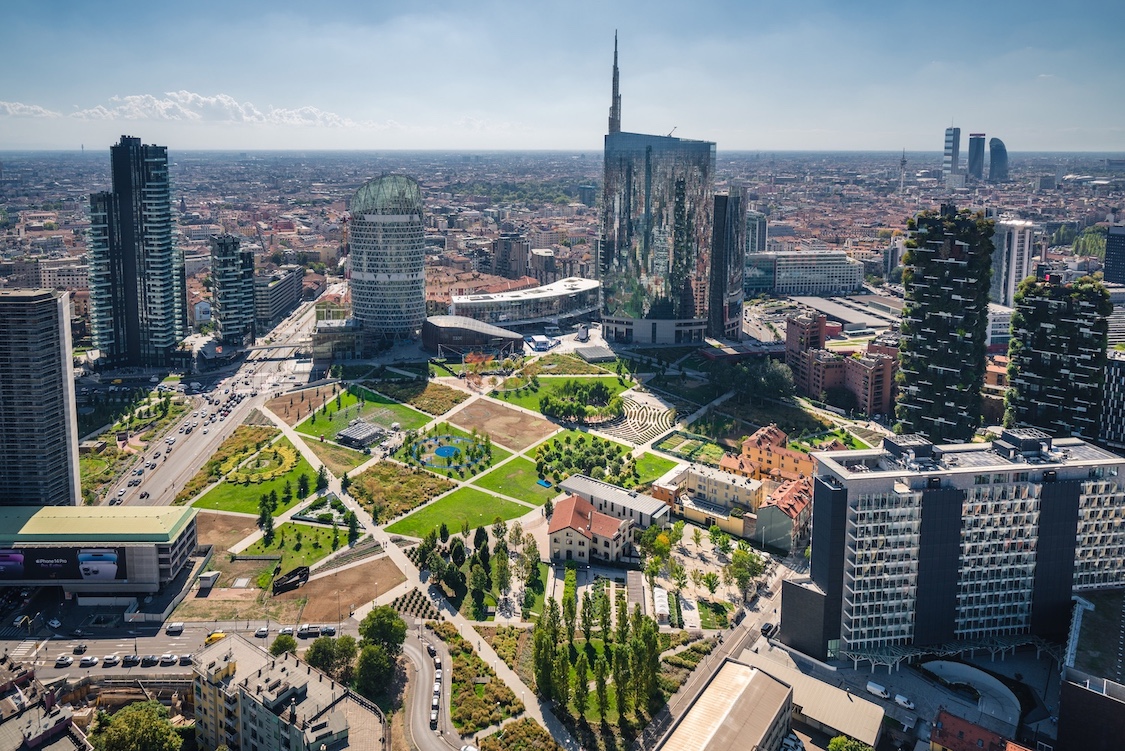
A clear example of a systemic smart-city vision – one that leverages cutting-edge tools while addressing the most urgent urban challenges, from climate change to increasing urbanization and resource scarcity – is Milan’s Portanuova district. Here, artificial intelligence acts as an enabler of profound change: it enhances property valuation, optimizes building operations, and enables advanced control over energy, flows, maintenance, and environmental quality. AI is used to monitor systems in real time and analyze video and image data to predict malfunctions, improve safety, and create a smoother, more intuitive user experience.
This transformation, however, goes well beyond technical operations. AI also plays an increasingly important role in shaping the urban experience. AI-powered user-experience applications help redesign public spaces based on the real needs of those who use them, equipping them with intuitive informational tools always at hand. By analyzing behavior, spatial flows, and interactions through apps, it becomes possible to design pathways, services, and environments that respond more precisely to people’s needs. Resta adds that AI also “makes it possible to monitor the equitable use of shared spaces, perceived safety, and the level of comfort provided to everyone who experiences them.”
Sustainability, too, is strengthened by intelligent data: “When integrated into business processes, AI can turn ESG principles into measurable and traceable actions. It can optimize energy consumption, monitor carbon footprints in real time, improve environmental quality, help design more inclusive spaces, and reinforce governance. AI is not just a performance accelerator but a tool for strategic coherence.”
But governance, too, can benefit from the advantages provided by artificial intelligence which, in Resta’s view, must become a tool to strengthen companies’ decision-making capabilities: “By automating ESG data analysis and integrating it into auditing, reporting, and strategic planning processes, AI enables greater transparency, traceability, and responsiveness. Companies that adopt these tools in a structured way will be able to demonstrate to stakeholders – investors, institutions, communities – their commitment in a documented, timely, and comparable manner.”
Only by leveraging the full potential of artificial intelligence in the ESG domain will smart cities truly become places where human well-being and innovation intertwine to enhance quality of life and foster growth and development. “The challenge of smart cities can be summarized by the very nature of ESG evaluation criteria and lies in the ability to coordinate strategic vision, digital innovation, and collective responsibility: technology is not an end in itself, but the means to achieve it. And truly intelligent cities must be, above all, profoundly human.”