

For a long time, cities were designed to function primarily during the day, with transport, services and public spaces planned and built around the traditional rhythms of daily life. Today, however, this model is no longer enough. Major metropolitan areas operate across an increasingly extended timeframe, with people working, travelling, studying, attending events and accessing services well into the evening and night.
“Milan is a clear example: hospitals, airports, logistics, universities, tourism, culture and major events generate flows of people that do not simply stop at the end of the working day.” Looking at this transformation through the lens of urban mobility is Giuseppe Vallelonga, Director and Mobility Planning expert at Systematica, a company specialised in mobility planning, pedestrian and vehicular flow analysis, urban accessibility and transport strategies supporting complex urban transformation projects.

Taking an integrated approach that considers infrastructure, public space and people’s behaviour, Vallelonga argues that the night should be seen as a structural component of the contemporary city: “There is no longer a clear separation between ‘productive time’ and ‘night-time’. The night is now an integral part of the urban metabolism and must be fully incorporated into the way we design cities, moving beyond the idea that it is simply associated with entertainment or represents a secondary dimension of urban life.”
In Italy alone, there are now more than 2.5 million night workers, accounting for 11% of the employed population, with particularly high numbers in healthcare, logistics, transport, hospitality and urban services. “Lombardy,” Vallelonga adds, “is the Italian region with the highest absolute number of night workers, and the Milan metropolitan area is one of the main hubs of the so-called ‘24-hour economy’.”
During the day, the widespread presence of people, activities and services tends to compensate for many of the weaknesses of public space. At night, however, single-use neighbourhoods, inactive streets, isolated public transport stops, empty underpasses, poorly lit routes and inefficient connections become far more critical.
This brings the issue of perceived safety to the forefront. Perceived safety cannot be measured solely through crime statistics, but also depends on the overall quality of the urban environment: “This is particularly relevant for older people, students, night workers, public transport users and, specifically, women.” A poorly lit street, an inaccessible bus or tram stop, or insufficient signage can significantly affect how safe a place feels. “Men, women and people with specific needs,” Vallelonga emphasises, “experience the city at night in different ways.”
Mobility is one of the key infrastructures of the night-time city. Even a city rich in high-quality public spaces and attractive cultural activities risks undermining their value if, after a certain hour, they are no longer easily accessible or connected. At night, reduced public transport frequency and longer waiting times often push people towards private cars, taxis and other individual mobility services. “The issue,” Vallelonga explains, “is not only how people move around, but under what conditions. An isolated transport stop, a long wait or a poorly lit route can substantially influence people’s choices.”
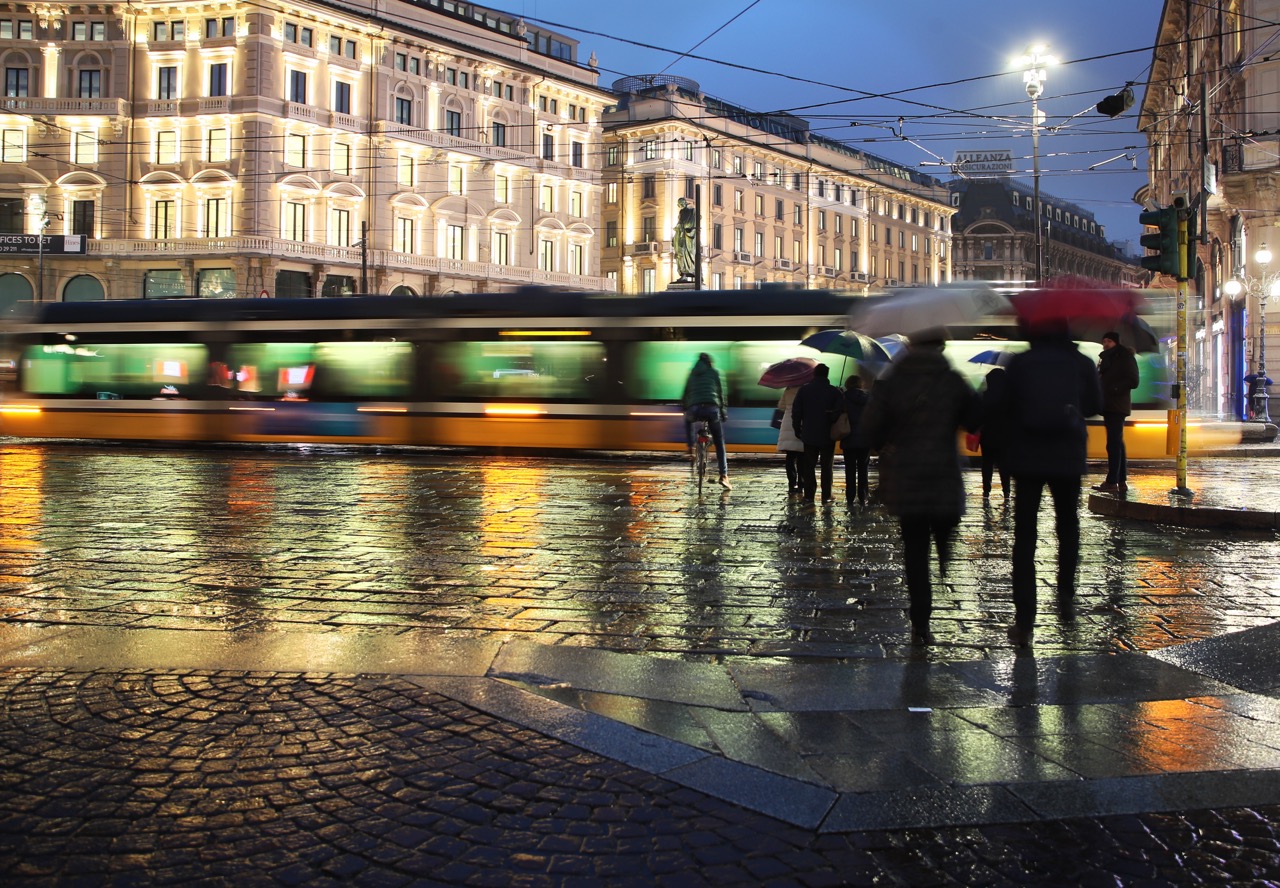
Mobility planning therefore cannot be limited to transport infrastructure alone. It must create genuine conditions for urban accessibility, through the continuity of public space, appropriate lighting, social presence and the integration of different functions. “Examples such as London’s night transport network, Barcelona’s NitBus and Copenhagen’s extensive cycling infrastructure show how evening and night-time mobility can become an integral part of urban quality rather than a marginal service,” Vallelonga adds.
Lighting is fundamental: “It should make routes easy to understand, eliminate blind spots, improve visual comfort, guide movement and create perceptual continuity without generating excessive light pollution. A city that is liveable at night is not a city that is permanently illuminated, but one that can adapt light, activity and functions to different places and different times,” Vallelonga explains.
Alongside lighting, cities need to focus on the functional mix and activation of ground-floor spaces. When homes, offices, shops, cultural venues and leisure spaces coexist within the same urban context, neighbourhoods do not empty out during particular times of day. Instead, they maintain a more continuous and distributed presence throughout the day and into the night. Single-use areas, by contrast, tend to empty quickly and become more vulnerable. “Food also plays an important role from this perspective,” Vallelonga notes. “Food halls, public markets and accessible food options available outside conventional hours become forms of social infrastructure, capable of fostering vitality, social interaction and a greater sense of safety.”
The night can therefore become a testing ground for urban regeneration. Addressing the night-time dimension means working simultaneously on mobility, urban welfare, perceived safety, neighbourhood retail, public space and environmental quality.
In this context, real estate must evolve too. “The value of an urban development no longer depends solely on the architectural quality of its buildings, but on its ability to create active, safe and accessible ecosystems throughout the 24-hour cycle. Projects such as Portanuova or the regeneration of Milan’s Darsena,” Vallelonga says, “have been successful because they have created continuity between day and night, integrating mobility, services, public space, retail and mixed uses.”
The challenge for the coming years will be to introduce a temporal dimension into urban planning, capable of understanding and managing the city’s different rhythms. “The quality of the night will undoubtedly become one of the key indicators of the overall quality of contemporary urban centres,” Vallelonga concludes. “Because it is precisely during the evening and night-time hours that inclusion, accessibility, perceived safety and a city’s genuine ability to work for everyone become most clearly visible.”

 Rethinking the night: a new frontier for urban regeneration