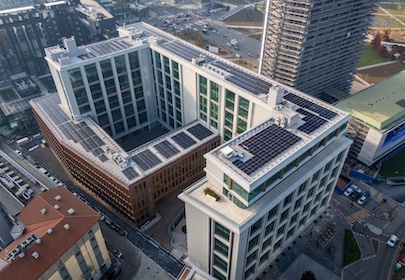
Much is said about urban regeneration, typically interpreted through the lenses of infrastructure, public green spaces, urban planning, safety, and citizens’ wellbeing. These are innovative initiatives that we have often explored in Urban Stories, observing how cities are changing their identity through new models of sustainability and inclusion. Yet there is another equally important dimension of public life that still tends to remain in the background: sound, which in the urban environment is an integral part of how we interact with the world around us.
The term increasingly used to describe this scenario is ‘soundscape’: an invisible yet crucial element in the quality of the urban experience, influencing our psychological and physical balance, our perception of safety, and the livability of spaces, even when we are not fully aware of it.
To explore these aspects in greater depth, we spoke with two professionals whose expertise complements one another: Sergio Luzzi, an expert in urban acoustics and President of the International Institute of Acoustics and Vibration, who has long been engaged in issues related to acoustic planning and the quality of urban soundscapes; and Alessandro Franconetti of Evoke the Spectrum, a sound design studio based in Milan and Rome specializing in immersive soundscapes and sonic identities for urban, cultural, and real estate environments, with an approach that integrates both the experiential and functional dimensions of sound in public space.

“Sound has enormous emotional power and is capable of completely transforming our perception of a space,” emphasizes Alessandro Franconetti.
From this awareness emerges a new question for contemporary design: how do we build a city that is not only beautiful to look at and functional to live in, but also harmonious to listen to? The issue is not merely about noise reduction, but about the overall comfort of the urban environment. “We are often unable to immediately recognize that our sense of wellbeing or discomfort in a place may be linked to sound. Yet this is precisely the case, because our experience and memory of a place are very often deeply connected to the sounds we heard there.”
Sergio Luzzi shares this perspective, referring to the concept of “global comfort”: “Acoustic quality is one of the factors contributing to the overall wellbeing of a place, together with light, temperature, air quality, and accessibility. It is therefore natural for the soundscape to become an integral part of the city’s multisensory design. The objective is not only to comply with regulatory limits, but also to actively contribute to creating more balanced and livable urban environments.”
In this regard, it is worth remembering that for many years the issue of urban acoustics was addressed almost exclusively in terms of mitigation. The aim was to reduce decibel levels, contain emissions, and prevent conflicts between different urban functions.
Today, however, the debate is moving toward a more advanced level: it is no longer enough simply to eliminate noise; quality must also be introduced. Luzzi highlights the importance of strategies such as sound masking and sound enrichment: “These are approaches capable of enhancing so-called ‘positive sounds,’ such as geophonies associated with water, wind, or vegetation, with the goal of masking more intrusive sources – traffic, systems, infrastructure – and improving the overall perception of space.”
This approach aligns perfectly with the design perspective embraced by Evoke the Spectrum. As Franconetti explains, “The challenge is not to add sounds artificially or decoratively, but to create a balance between silence, sonic presence, and the identity of the place. A city is never completely silent: what changes is the quality and coherence of its acoustic landscape. This is why targeted and strategic sound (and silence) design within an urban ecosystem can be crucial in creating wellbeing.”
For example, when designing a new urban transport hub aimed at improving traffic management, the equation should also include the acoustic impact that vehicles passing through the area will have compared to the previous situation, proposing solutions in the same way that urban furniture or green spaces are planned.
The management of urban sound, however, is only one aspect of sound in the city. Referring to the dimension of “urban branding,” Franconetti points out how sound can also become an identity-defining element.
On closer inspection, this is something we all intuitively recognize when we hear the distant ringing of church bells that characterizes the Italian landscape, or the call of a muezzin summoning the faithful in a Middle Eastern city. Today, it is possible to intentionally design these effects through the sonic planning of an urban district. “An entire city, or one of its districts, can also be designed through the development of its own distinct ‘sonic identity.’” This approach, defined as ‘Urban Audio Branding’, concerns not only the symbolic dimension but also the functional one. Sound can orient, inform, make networks and spaces recognizable, direct the flow of people in a specific direction, draw attention to signage, or signal danger.
From transport networks to museums and commercial buildings, the sonic dimension can help strengthen user experience and improve the management of flows, traffic, construction sites, nightlife, and events.
An approach fully acknowledged by Sergio Luzzi, who notes: “Acoustic planning must become part of urban masterplans through classification, mapping, and regulatory tools, in order to prevent critical issues and conflicts between different urban functions.”
Moreover, time itself is a key variable: between day and night, changing seasons, and varying weather conditions, the city never “sounds” the same, and acoustic design must take this constant transformation into account.
Both experts agree on one point: acoustics cannot be treated as a late-stage intervention, nor as an element to be modified afterward except through simple mitigation measures. Franconetti observes that in Italy sound is still often considered a secondary element during the design phase, while Luzzi stresses the importance of integrating the acoustic dimension from the earliest stages of urban planning through decisions concerning mobility, the distribution of functions, and the protection of quiet areas.
Designing silence does not mean eliminating sound. It means creating a city capable of generating harmony among its different components, where positive sounds can “mask noise” and contribute to a more balanced experience. The city of the future will not only be greener, more digital, or more connected, but also more aware of its own voice.