

-
10 things to know about our sustainability report
Before leaving you to the complete reading, we anticipate some points of particular attention that have marked a year of great results.
Before leaving you to the complete reading, we anticipate some points of particular attention that have marked a year of great results:
- Over 50% of the portfolio classified as Article 8 or Article 9 under SFDR – continued strategic reallocation, with further alignment of the portfolio to COIMA’s sustainability objectives.
- ESG excellence funds – five COIMA funds recognized as GRESB Global Sector Leaders, confirming outstanding ESG performance and a strong positioning in key industry benchmarks.
- – 11% portfolio carbon intensity – strengthening of the decarbonization plan, with a focus on embodied carbon in new developments.
- 62% renewable energy consumption – increasing vs. 2024, with a target of 100% by 2030 and a progressively fossil-free portfolio.
- Optimization of energy and environmental performance – completion of tests for the integration of artificial intelligence in the management of building HVAC systems, confirming energy savings of approximately 10%.
- Delivery of the Olympic Village to Fondazione Milano Cortina – completed in just 30 months, representing the first milestone in the regeneration of the former Porta Romana rail yard.
- 30% green space in every development – An integrated strategy to increase biodiversity and improve urban quality of life.
- Social Impact Framework – publication of impact reports for the COIMA ESG City Impact Fund and Portanuova.
- Award of the former “Guido Reni” site – confirmation of the development assignment to COIMA SGR through the Impact Fund.
- +350 cultural events with Fondazione Riccardo Catella – with BAM receiving international recognition for its contribution to sustainable urban development.
Download the Sustainability Reports
Sustainability Report 2025
Sustainability Report 2024
Sustainability Report 2023
Sustainability Report 2022
Sustainability Report 2021
Sustainability Report 2020
Sustainability Report 2019
Sustainability Report 2018
Sustainability Report 2017
Sustainability Report 2016
Sustainability Report 2015
-
Portanuova in Milan is one of the most significant urban regeneration projects carried out in the historic centre of a European city.
Through a unified and shared vision, aligned with the active “Portanuova Impact” strategy, COIMA has taken on a broader role in the coordination and management of the district, overseeing its development, management and adding the implementation of a multidimensional activation proposal for the neighbourhood.
Thanks to a systemic approach, all stakeholders have contributed to the creation of projects focused on social, environmental, cultural and digital innovation, with the aim of generating impacts that go beyond the boundaries of the neighbourhood, turning it into a laboratory for sustainable development.
To understand the impacts generated by activities and initiatives related to the management of the neighbourhood, a monitoring and evaluation framework based on the principles of the Theory of Change was adopted, with the support of a team specialised in impact sustainability.
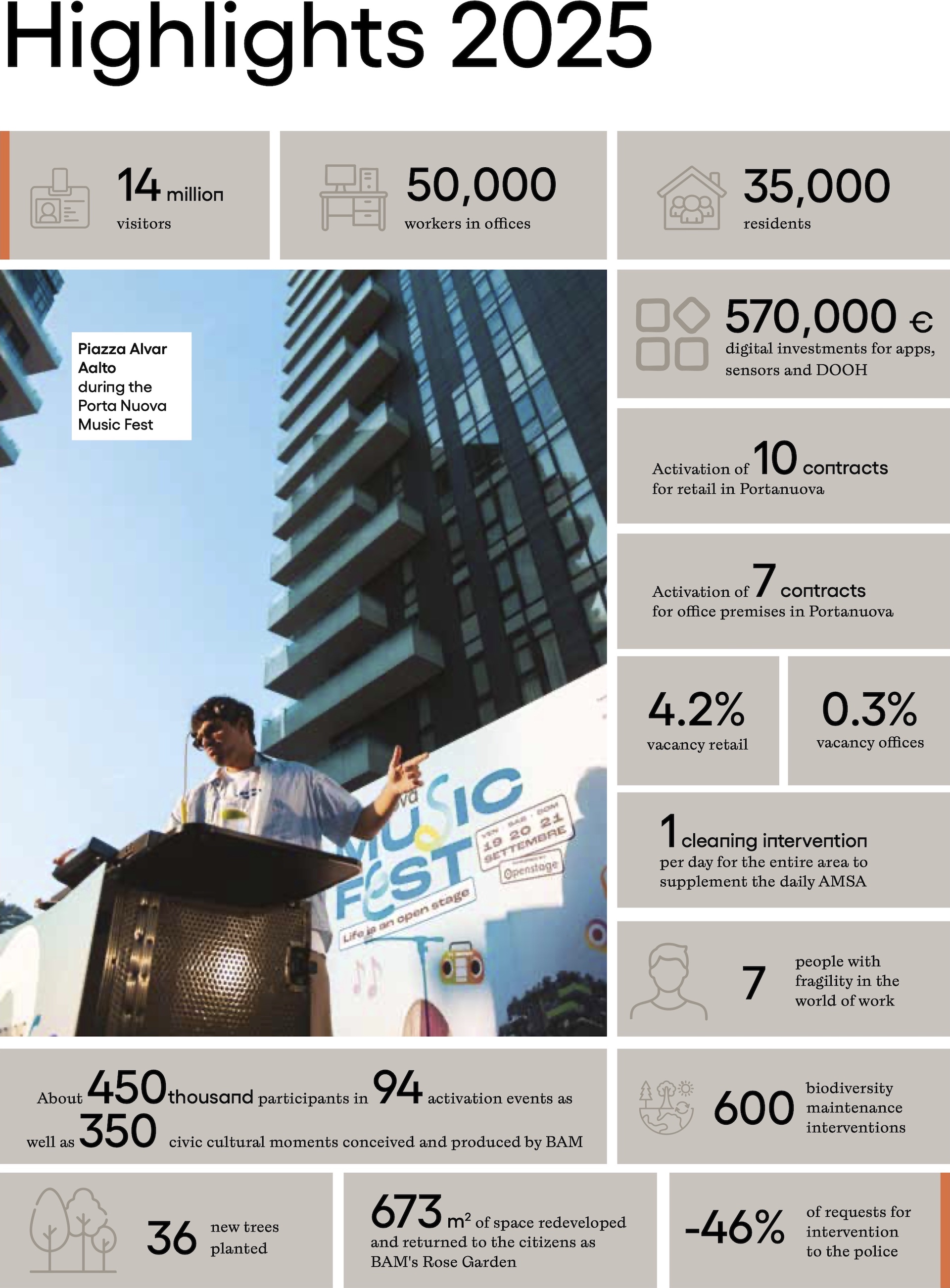
The analysis includes all activities related to the management of private and public spaces, the editorial programme of Portanuova events, the activities of Fondazione Riccardo Catella including the cultural and educational moments of the BAM – Biblioteca degli Alberi Milano programme.
We are pleased to share the Porta Nuova Impact Report.
Download the Porta Nuova Impact Reports
Porta Nuova Impact Report 2025
Porta Nuova Impact Report 2024
-
Climate Risk and Urban Resilience: A Scientific Approach for Real Estate
Climate change is increasingly shaping the future of cities and the performance of real estate assets. Understanding how climate-related hazards—such as extreme heat, intense rainfall, and wind exposure—interact with the built environment is becoming essential for responsible urban development and long-term asset value preservation.
In collaboration with IUAV University of Venice, COIMA has developed a white paper on Climate Risk and Vulnerability Assessment (CRVA) applied to the urban context of Milan. The study introduces a structured methodology that combines climate data, urban morphology, and real estate analysis to identify potential vulnerabilities and support the integration of climate adaptation strategies across the real estate lifecycle.
The research illustrates how climate risk analysis can inform investment decisions, design strategies, and asset management practices, providing a practical framework to support the development of more resilient buildings and districts.
The approach presented represents a first step toward a replicable methodology for integrating climate risk considerations into real estate development and management.
IUAV White Paper – Climate Risk and Vulnerability Assessment
-
The 2025 Impact Report of the Impact Fund outlines the evolution of an urban regeneration model that integrates sustainability, innovation, and value creation for the country.
The Fund successfully combines financial returns consistent with its risk profile with tangible benefits for local communities. Its capital structure – open, scalable, and collaborative – also enables the amplification of investment impact: every euro committed to the Fund mobilizes additional private and institutional resources, currently generating a total of €5 billion with a 5x multiplier, and with the potential to reach €12 billion upon full development of the existing portfolio.
This model enhances economic, social, and environmental impact, fostering structured collaboration among the public sector, private sector, and local communities.
In its first five years, the Fund has generated 13,700 jobs, €3.6 billion in economic activity, and €1.9 billion in GDP contribution, through projects in strategic areas such as the Milan Cortina 2026 Olympic Village, Scalo di Porta Romana, MilanoSesto, and the former Guido Reni Barracks. All completed buildings are fossil fuel–free, Class A, and nZEB, confirming a strong commitment to decarbonization and energy efficiency. At the same time, the Fund directly contributes to housing policy: 13,300 new residential units are planned, including approximately 2,400 affordable units, as well as 1,700 subsidized student beds in the new Olympic Village student housing, scheduled to be operational from 2026/27.
This approach has received international recognition: in 2025, the Fund was awarded the GRESB Global Sector Leader title for the fourth consecutive year, achieving a score of 99/100 and a 5-star rating.
The combination of strategic ambition, measurable impact, and institutional collaboration positions the Fund as a concrete tool for building more resilient, inclusive, and sustainable cities.
The Impact Report thus stands not only as a reporting exercise, but as an annual commitment to transparency and strategic direction, supporting urban development capable of generating long-term benefits for communities, territories, and the national system.
COIMA ESG City Impact Fund – Impact Report 2025